
Augmented Reality vs Virtual Reality: What's the Difference?
Ever tried on a VR headset and felt like you were suddenly transported to another world? Or pointed your phone camera at a space to see how a piece of furniture might look in your living room? These experiences highlight the fundamental AR vs VR differences that are reshaping how we interact with digital content.
As immersive technologies continue to evolve, understanding the distinction between augmented reality (AR) and virtual reality (VR) becomes increasingly important. You'll encounter these technologies in gaming, education, healthcare, and countless other industries – but they function in fundamentally different ways and serve different purposes.
In this comprehensive guide, we'll explore what makes AR and VR unique, how they work, their practical applications, and which technology might be better suited for your specific needs.
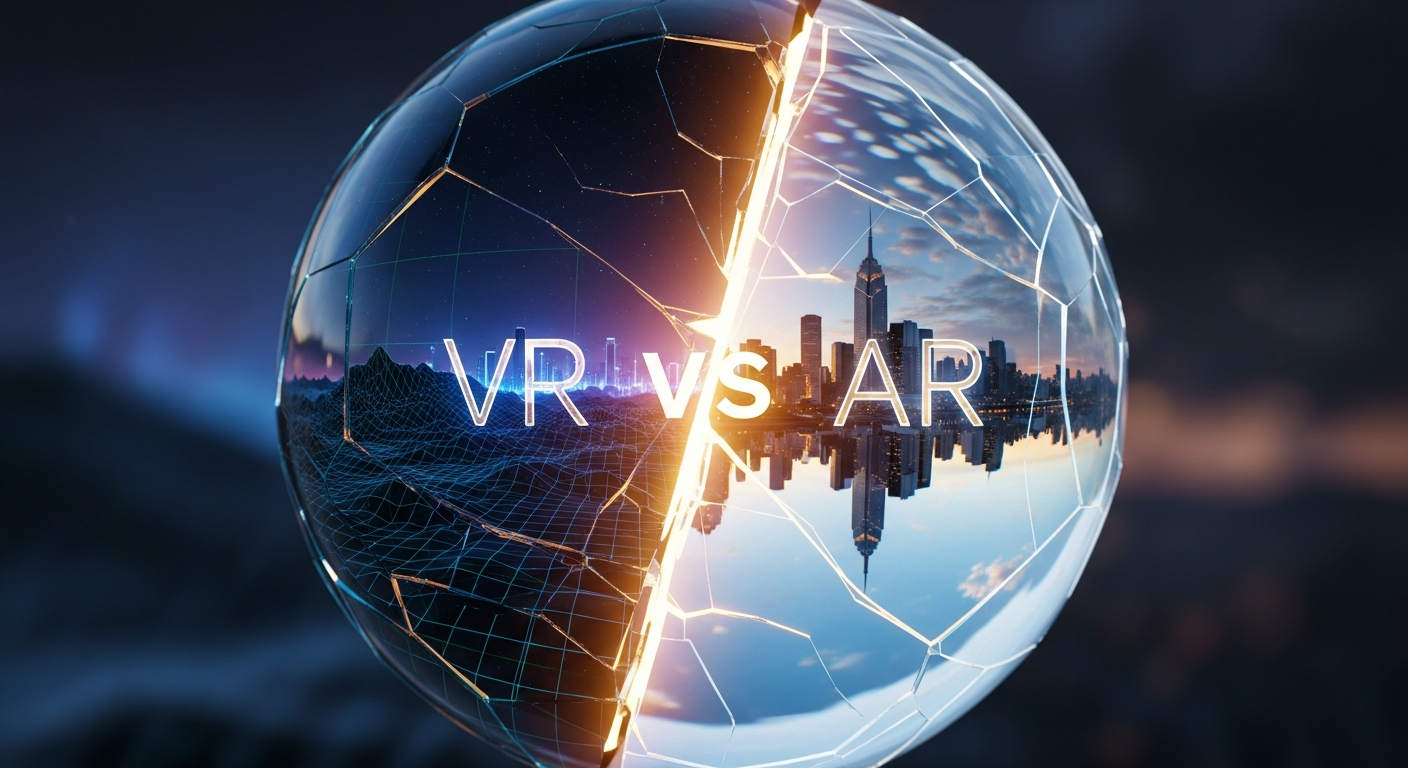
Table of Contents
- Defining AR and VR: Core Concepts
- Technical Differences Between AR and VR
- User Experience: How AR and VR Feel Different
- Hardware Requirements and Accessibility
- Practical Applications Across Industries
- Limitations and Challenges
- Future Trends and Convergence
- Conclusion: Choosing Between AR and VR
- Frequently Asked Questions
Defining AR and VR: Core Concepts {#defining-ar-vr}
At their core, AR vs VR differences revolve around how they alter your perception of reality.
Virtual Reality (VR) creates a completely immersive experience by replacing your physical surroundings with a digital environment. When you wear a VR headset, you're effectively transported to a different world that completely replaces what you see, hear, and sometimes even feel. This technology isolates you from your physical environment to create a sense of presence in a virtual space.
Augmented Reality (AR), on the other hand, enhances your existing environment by overlaying digital information onto the real world. Rather than replacing reality, AR adds to it through smartphones, tablets, or specialized glasses. This allows you to maintain awareness of your surroundings while interacting with digital elements that appear to exist in your physical space.
These fundamental differences in approach make each technology suitable for different types of applications and experiences. AR vs VR comparison discussions often center around this reality spectrum – from enhancement to complete immersion.
Technical Differences Between AR and VR {#technical-differences}
The technical implementation of these technologies further highlights the AR vs VR differences:
VR Technical Framework:
- Requires powerful processing to render entire 3D environments
- Uses head-mounted displays with screens for each eye
- Employs motion tracking to update visuals as you move
- Often includes controllers for interaction within the virtual space
- Requires dedicated hardware specifically designed for immersion
AR Technical Framework:
- Uses cameras to capture the real world
- Employs computer vision to understand physical spaces
- Overlays digital content onto camera feed or transparent displays
- Can work with existing hardware like smartphones
- Often utilizes location data and sensors for contextual awareness
Both technologies rely on sophisticated spatial tracking, but VR must create an entire world while AR needs to understand and enhance the existing one. This distinction directly impacts hardware requirements, processing needs, and potential applications.
User Experience: How AR and VR Feel Different {#user-experience}
The user experience between AR and VR creates perhaps the most noticeable AR vs VR differences:
VR Experience:
- Complete immersion with no visibility of physical surroundings
- Powerful sense of "presence" in another reality
- Often requires dedicated space for movement
- Can cause motion sickness in some users
- Typically requires session-based use (putting on/taking off headset)
AR Experience:
- Maintains awareness of physical environment
- Digital objects appear to interact with real world
- Can be used while moving through everyday environments
- Generally more accessible for quick interactions
- Often social since multiple users can see the same augmented elements
These experiential differences make VR ideal for deep immersion activities like gaming and simulation training, while AR excels in contexts where maintaining awareness of your surroundings is crucial, such as navigation or workplace assistance.
Hardware Requirements and Accessibility {#hardware-requirements}
The hardware necessary for each technology reflects their fundamentally different approaches:
VR Hardware:
- Dedicated headsets (Oculus Quest, HTC Vive, PlayStation VR)
- Powerful processing for rendering full environments
- Often requires external sensors or cameras for tracking
- Hand controllers for interaction
- Sometimes needs a connected PC or game console
AR Hardware:
- Can function on smartphones and tablets
- Specialized glasses (Microsoft HoloLens, Magic Leap)
- Lighter, less obtrusive wearables
- Uses existing cameras and sensors
- Generally more portable
This hardware distinction makes AR more immediately accessible to average consumers who already own smartphones, while VR typically requires a dedicated purchase decision. As AR vs VR comparison analyses show, this accessibility factor significantly impacts adoption rates and use cases.
Practical Applications Across Industries {#practical-applications}
Both technologies excel in different contexts:
VR Applications:
- Gaming and entertainment
- Medical training and surgical simulation
- Therapeutic treatments (exposure therapy, pain management)
- Architecture visualization and walkthrough
- Remote collaboration in fully virtual spaces
- Immersive education and training
AR Applications:
- Retail (virtual try-on, furniture placement)
- Industrial maintenance and repair guidance
- Navigation and wayfinding
- Educational overlays for museums and historical sites
- Enhanced sports viewing with live stats
- Social media filters and effects
These applications highlight how AR vs VR differences translate into practical use cases that leverage each technology's strengths.
Limitations and Challenges {#limitations-challenges}
Both technologies face distinct barriers to wider adoption:
VR Challenges:
- Physical isolation from surroundings
- Motion sickness and comfort issues
- Higher hardware costs
- Limited mobility while in use
- Requires dedicated time and space
AR Challenges:
- Limited field of view in current hardware
- Tracking accuracy in complex environments
- Processing power on mobile devices
- Battery life constraints
- Privacy concerns with always-on cameras
Understanding these limitations is crucial when evaluating which technology might be appropriate for specific use cases or audiences.
Future Trends and Convergence {#future-trends}
The future may see these technologies blend into a spectrum of "mixed reality" experiences:
- Mixed Reality (MR): Combines elements of both AR and VR
- Extended Reality (XR): Umbrella term for all immersive technologies
- Lighter, more comfortable hardware: Reducing barriers to regular use
- Improved haptic feedback: Adding touch sensations to virtual interactions
- 5G and edge computing: Enabling more powerful processing and real-time responses
Many experts believe that AR vs VR differences will gradually blur as technologies evolve toward more seamless integration between physical and digital realities.
Conclusion: Choosing Between AR and VR {#conclusion}
The choice between AR and VR ultimately depends on your specific needs and use cases. Virtual reality offers unparalleled immersion when you want to transport users to entirely new environments, making it ideal for gaming, simulation training, and therapeutic applications. Augmented reality shines when you need to enhance real-world contexts with digital information, perfect for retail, navigation, industrial applications, and casual consumer use.
Rather than viewing AR vs VR differences as a competition, consider them complementary technologies serving different points on the immersion spectrum. As hardware becomes more affordable and software more sophisticated, we'll likely see increased adoption of both technologies across industries and consumer applications.
Ready to explore these immersive technologies further? Consider trying an AR application on your smartphone or visiting a VR arcade to experience the differences firsthand. The future of how we interact with digital information is becoming increasingly three-dimensional!
Frequently Asked Questions {#faqs}
Which is more expensive, AR or VR?
Generally, VR requires more dedicated hardware investment upfront (headsets, controllers, possibly a gaming PC), making it typically more expensive than AR, which can often run on existing smartphones or tablets. However, enterprise-grade AR headsets can be quite costly as well.
Is AR or VR better for gaming?
VR typically offers more immersive gaming experiences by transporting you to entirely new worlds. AR games (like Pokémon GO) excel at blending gameplay with real-world movement and social interaction. The best choice depends on the type of gaming experience you prefer.
Can I experience AR or VR without special equipment?
Basic AR experiences are accessible through most modern smartphones. VR requires at minimum a headset, though simple cardboard viewers paired with smartphones can provide entry-level experiences.
Does AR or VR cause motion sickness?
VR is more commonly associated with motion sickness due to potential mismatches between visual and vestibular signals. AR typically causes fewer motion sickness issues since you remain grounded in the physical world.
Which technology is advancing faster, AR or VR?
Both are advancing rapidly, but AR vs VR comparison trends suggest AR may see wider mainstream adoption first due to lower barriers to entry and integration with everyday devices like smartphones.
Are there professional opportunities in AR and VR development?
Absolutely. Both fields are growing rapidly, with demand for developers, designers, UX specialists, and content creators. Learning either technology can open doors to careers in gaming, healthcare, education, retail, and many other industries.
Can AR and VR be used together?
Yes, mixed reality (MR) approaches combine elements of both AR and VR, allowing digital objects to interact with the real world while also creating immersive environments. This convergence represents an exciting frontier in immersive technology.