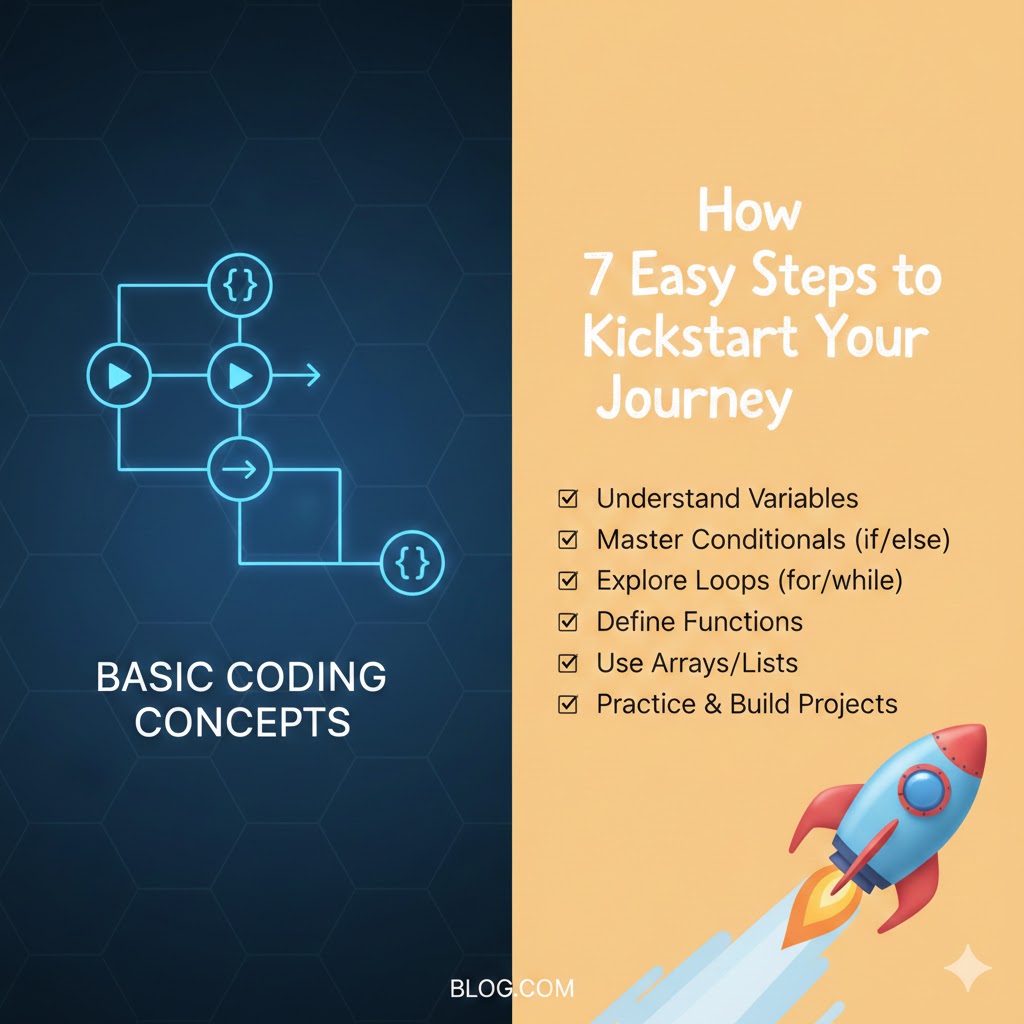
Basic Coding Concepts: How 7 Easy Steps to Kickstart Your Journey
Introduction
Have you ever stared at a screen full of code and felt completely lost? You're not alone. In today's digital world, understanding how to communicate with computers has become nearly as important as knowing how to read and write. Whether you're looking to change careers, enhance your current skill set, or simply understand how the digital products you use daily function, learning basic coding concepts is your gateway to this new literacy. The good news? You don't need to be a math genius or technical whiz to get started. This guide breaks down the fundamental steps to begin your coding journey with confidence.
What Are Basic Coding Concepts?
Basic coding concepts are the foundational principles that underpin all programming languages. Think of them as the alphabet and grammar rules before writing essays. These concepts include variables, data types, loops, conditionals, functions, and algorithms. Understanding these fundamentals makes learning any programming language significantly easier, whether you're interested in web development, mobile apps, data science, or artificial intelligence.
Coding basics for beginners are designed to be approachable and practical, focusing on logical thinking rather than complex mathematics. Most importantly, these concepts are transferable – once you understand them in one language, you can apply them to others with minimal adjustment.
Key Programming Fundamentals to Learn First
Before diving into specific languages, familiarize yourself with these core concepts that form the backbone of all coding:
- Variables and Data Types: How computers store and manipulate different kinds of information
- Control Structures: How to make decisions (if/else statements) and repeat actions (loops)
- Functions: How to organize code into reusable blocks
- Algorithms: Step-by-step procedures for solving problems
- Syntax: The specific rules and structure of programming languages
Learning these basic coding concepts first creates a solid foundation for everything that follows.
7 Steps to Start Your Coding Journey
Step 1: Choose a Beginner-Friendly Language
For newcomers, Python is often recommended due to its readable syntax and versatility. JavaScript is another excellent choice, especially if you're interested in web development. Both languages have massive communities and abundant learning resources.
Step 2: Set Up Your Learning Environment
Install the necessary tools for your chosen language:
- A code editor (VS Code, Sublime Text)
- The language interpreter or compiler
- Version control system (Git)
Many beginners benefit from starting with online coding platforms like Replit or CodePen, which require no setup at all.
Step 3: Learn the Syntax Basics
Begin by understanding how to write simple statements in your chosen language. Focus on:
- How to create variables
- Basic operations (addition, subtraction, etc.)
- How to display output
- How to get user input
Step 4: Master Control Structures
Learn how to make your code make decisions and repeat actions:
- If/else statements for conditional logic
- For and while loops for repetition
- How to combine conditions with logical operators
These basic coding concepts are the building blocks for more complex programs.
Step 5: Practice with Small Projects
Apply what you've learned by building simple applications like:
- Calculator
- To-do list
- Simple games (guess the number, tic-tac-toe)
- Basic data analysis scripts
Small victories build confidence and reinforce learning.
Step 6: Learn to Debug
Debugging is an essential skill for every programmer:
- Understand common error messages
- Use print statements to track program flow
- Learn to use debugging tools in your environment
- Practice troubleshooting systematically
Step 7: Join a Community
Connect with other learners and experienced developers:
- Coding forums like Stack Overflow
- Social platforms like Discord or Reddit
- Local meetups or coding groups
- Online learning communities
Common Mistakes to Avoid
When learning basic coding concepts, watch out for these pitfalls:
- Trying to learn everything at once: Focus on one concept at a time
- Not practicing regularly: Coding is a skill that requires consistent practice
- Copying code without understanding: Always try to understand how solutions work
- Getting stuck in tutorial hell: Start building your own projects early
Conclusion
Embarking on your coding journey doesn't have to be intimidating. By following these seven steps and focusing on basic coding concepts rather than trying to master everything at once, you'll build a solid foundation for continued growth. Remember that every expert programmer once started exactly where you are now – learning one concept at a time. The key is consistency, patience, and curiosity. Start small, celebrate your progress, and before you know it, you'll be solving problems and building applications you never thought possible.
FAQs
Do I need to be good at math to learn coding?
No, most programming only requires basic math skills. Logical thinking is more important than advanced mathematics for beginners.
How long does it take to learn basic programming?
Most beginners can grasp the fundamentals in 2-3 months of consistent study and practice. Becoming proficient takes longer but you'll see progress quickly.
Can I learn coding for free?
Absolutely! There are countless free resources online including documentation, tutorials, videos, and interactive platforms.
Which programming language should I learn first?
Python is widely recommended for beginners due to its readable syntax, but JavaScript is also excellent, especially for web development.
Is coding hard to learn?
Learning to code is like learning any new skill – it takes time and practice but is certainly achievable with persistence.