
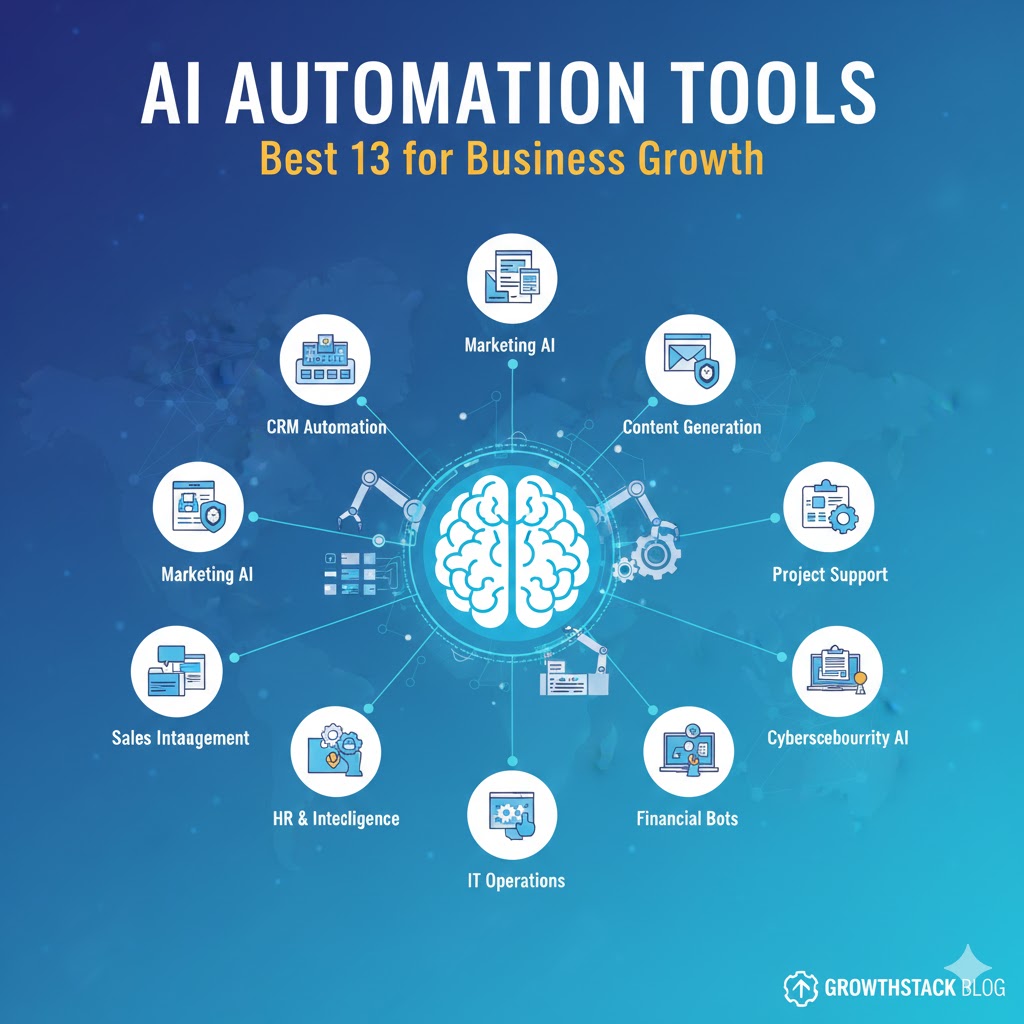
AI Automation Tools: Best 13 for Business Growth
Introduction
Is your business drowning in repetitive tasks while your competition races ahead with innovation? You’re not alone. The average knowledge worker spends 41% of their workweek on mundane, repeatable tasks that could be automated. In today’s hyper-competitive landscape, leveraging ai automation tools isn’t just a luxury—it’s a necessity for sustainable growth. These powerful technologies are revolutionizing how businesses operate, enabling teams to focus on strategic initiatives while artificial intelligence handles routine operations with unprecedented efficiency and accuracy.
Tool & Technology Overview

AI powered automation solutions, represent a category of technologies that leverage machine learning, natural language processing, and robotic process automation to perform tasks traditionally handled by humans. These solutions are ideal for businesses of all sizes—from startups looking to maximize limited resources to enterprises seeking operational excellence at scale.
The core value proposition is simple: automate repetitive, rule-based tasks to reduce human error, cut operational costs, and free up talent for higher-value work. Modern AI automation integrates seamlessly with existing business systems, creating an interconnected ecosystem that optimizes workflows across departments.
Key Features & Capabilities
The top AI automation tools for business growth offer:
- Intelligent Document Processing: Extract, classify, and route information from invoices, contracts, and forms with 95%+ accuracy
- Natural Language Capabilities: Interact with systems using everyday language for customer service, data analysis, and internal knowledge management
- Low/No-Code Development: Build automation workflows without extensive programming knowledge
- Cross-Platform Integration: Connect with CRM, ERP, marketing platforms, and custom business applications via robust APIs
- Predictive Analytics: Identify trends and anomalies to inform proactive business decisions
- Autonomous Decision-Making: Configure AI to make routine decisions based on predefined rules and parameters
- Cloud-Native Architecture: Scale resources up or down based on real-time demand
Setup & Requirements
Before implementing AI automation, ensure you have:
- Clear identification of processes suitable for automation (repetitive, rule-based, high-volume tasks)
- Data access and quality assessment (automation is only as good as your data)
- Executive sponsorship and change management planning
- IT infrastructure readiness (cloud resources, integration capabilities)
- Security and compliance frameworks to protect sensitive information
Most modern solutions offer cloud-based deployment with minimal on-premises requirements, though enterprise solutions may provide hybrid options for sensitive operations.
Step-by-Step Implementation Guide

- Process Assessment: Identify high-impact, low-complexity processes for initial automation (e.g., invoice processing, customer onboarding)
- Tool Selection: Choose from our recommended tools based on your specific use case and integration requirements
- Pilot Implementation: Start with a limited scope to demonstrate value and refine your approach
- Change Management: Train teams on how to work alongside automated systems
- Iterative Expansion: Gradually increase automation scope based on success metrics and lessons learned
- Continuous Optimization: Regularly review automation performance and refine using AI-driven insights
Use Cases & Real-World Applications
Successful businesses are using AI automation across various functions:
- Finance: Reducing invoice processing time from 10 days to 24 hours while improving accuracy by 35%
- Customer Service: Handling 80% of routine inquiries automatically, increasing CSAT scores by 15%
- HR: Cutting recruitment cycles by 40% through automated screening and scheduling
- Sales: Identifying high-potential leads with 3x better conversion rates through behavioral analysis
- Operations: Optimizing inventory management to reduce carrying costs by 25%
Pros, Limitations & Considerations
Advantages:
- 40-70% cost reduction for automated processes
- 24/7 operation without fatigue or quality degradation
- Scalability to handle volume fluctuations without additional staffing
- Improved compliance through consistent application of rules and documentation
Limitations:
- Initial implementation costs and learning curve
- Potential resistance from employees concerned about job displacement
- Need for human oversight on complex judgment-based decisions
- Ongoing maintenance and training requirements as business needs evolve
Tips, Best Practices & Optimization Advice
- Start with high-volume, low-complexity processes for quick wins
- Invest in proper change management to ensure employee adoption
- Design for exceptions and edge cases from the beginning
- Build feedback loops to continuously improve automation accuracy
- Maintain human oversight for sensitive decisions and quality assurance
Common Mistakes to Avoid
- Automating broken processes (fix the process first, then automate)
- Neglecting employee involvement and training
- Failing to establish clear success metrics before implementation
- Underestimating maintenance and governance requirements
- Over-automating processes that benefit from human judgment
Maintenance, Updates & Scaling
Successful AI automation requires:
- Dedicated ownership for each automated process
- Regular performance reviews against KPIs
- Systematic testing of updates before deployment
- Scalability planning for business growth
- Integration with emerging technologies as they mature
Conclusion
The strategic implementation of AI automation tools represents one of the most significant competitive advantages available to modern businesses. Organizations that successfully deploy these technologies report an average 25% increase in operational efficiency and 20% reduction in costs while improving customer and employee satisfaction.
The 13 tools highlighted in this guide offer varying approaches to automation, but they share a common promise: transforming how work gets done to accelerate business growth. Start small, measure carefully, and scale confidently to realize the full potential of AI automation in your organization.
FAQs
Which industries benefit most from AI Automation Tools?
While all sectors can benefit, financial services, healthcare, manufacturing, and professional services typically see the highest ROI due to their process-intensive operations.
How long does implementation typically take?
Simple workflows can be automated in weeks, while complex enterprise-wide implementations may take 6-12 months for full deployment.
Will AI automation replace jobs in my company?
Research shows AI typically augments rather than replaces workers, shifting focus from routine tasks to more strategic and creative contributions.
What’s the typical ROI timeframe?
Most businesses see positive ROI within 3-9 months for targeted implementations, with enterprise-wide initiatives showing returns within 12-18 months.
How can I ensure security with AI automation?
Choose solutions with robust encryption, access controls, audit trails, and compliance certifications relevant to your industry.