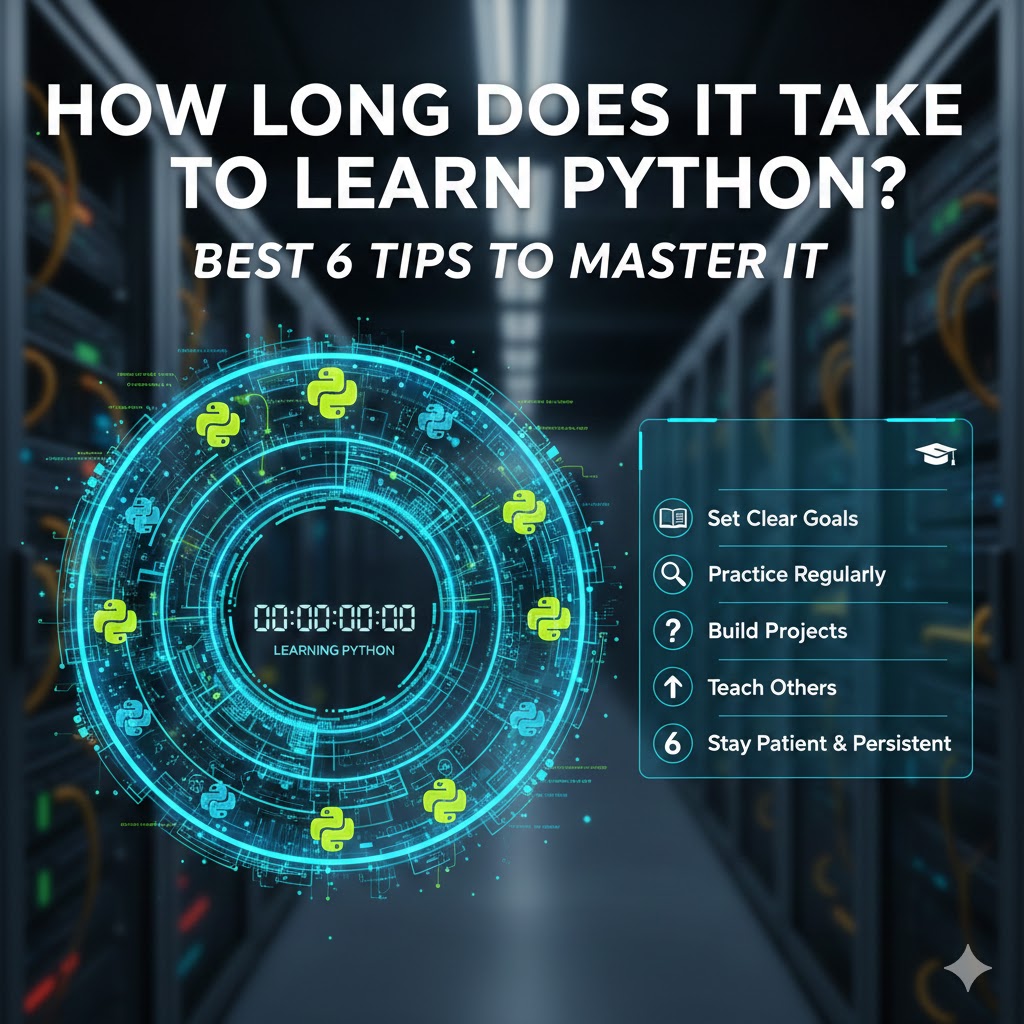
How Long Does It Take to Learn Python: Best 6 Tips to Master It
Have you been wondering about diving into Python programming but aren’t sure about the time commitment? Learning how long does it take to learn Python depends on various factors, including your background, goals, and dedication. Whether you’re a complete beginner or someone with programming experience looking to add Python to your skillset, understanding the timeline can help you plan your learning journey effectively.

In this comprehensive guide, we’ll explore the realistic timeframes for learning Python at different proficiency levels, factors that influence your learning speed, and practical tips to accelerate your Python mastery. By the end, you’ll have a clear roadmap to guide your Python learning journey.
- Understanding Python Learning Timeline
- Factors Influencing How Long Does It Take to Learn Python
- Realistic Timeframes for Different Proficiency Levels
- 6 Effective Tips to Accelerate Your Python Learning
- Best Resources for Learning Python
- Real-World Applications of Python
- Common Challenges and How to Overcome Them
- Conclusion
- Frequently Asked Questions
Understanding Python Learning Timeline {#understanding-python-learning-timeline}
Python’s learning curve is widely considered more gentle than many other programming languages. Its clean syntax, readability, and extensive standard library make it approachable for beginners. However, mastering Python is a journey that unfolds in stages, not an overnight achievement.
When discussing how long does it take to learn Python, it’s important to define what “learning Python” means to you. Are you aiming to:
- Understand basic syntax and write simple scripts?
- Build web applications using frameworks like Django or Flask?
- Develop data analysis skills with libraries like Pandas and NumPy?
- Master machine learning with scikit-learn and TensorFlow?
Each goal represents a different depth of knowledge and requires varying time investments. Let’s explore the factors that influence your learning timeline.
Factors Influencing How Long Does It Take to Learn Python {#factors-influencing-how-long-does-it-take-to-learn-python}
Several key factors determine how quickly you can learn Python:
1. Prior Programming Experience
If you’ve worked with other programming languages, you’ll likely pick up Python faster since you already understand fundamental programming concepts like variables, loops, and functions. Complete beginners may need extra time to grasp these foundational concepts.
2. Learning Method
Your approach to learning significantly impacts your timeline:
- Self-paced online courses
- Bootcamps
- University programs
- Books and documentation
- Project-based learning
Intensive bootcamps might help you progress quickly but require full-time dedication, while self-paced learning offers flexibility but may extend your timeline.
3. Time Commitment
Perhaps the most significant factor is how many hours per week you can dedicate to learning Python. Consistent practice accelerates your progress:
- Part-time (5-10 hours/week)
- Full-time (40+ hours/week)
4. Learning Goals
Your specific goals with Python will define the depth of knowledge needed:
- Basic scripting requires less time
- Web development demands familiarity with frameworks
- Data science requires statistical knowledge and specialized libraries
- Machine learning involves complex algorithms and mathematical concepts
5. Learning Style
Some people learn best through:
- Reading documentation
- Watching video tutorials
- Practical exercises
- Building projects
- Group learning
Finding a method that matches your learning style can significantly reduce the time it takes to become proficient.
Realistic Timeframes for Different Proficiency Levels {#realistic-timeframes-for-different-proficiency-levels}
Let’s break down how long does it take to learn Python for different proficiency levels:
Beginner Level (1-3 months)
At this stage, you’ll understand:
- Basic syntax and data types
- Control structures (if/else, loops)
- Functions and basic modules
- Simple file operations
Practical Example:
# A simple program demonstrating beginner Python skills
def calculate_average(numbers):
    total = sum(numbers)
    return total / len(numbers)

scores = [85, 92, 78, 90, 88]
average = calculate_average(scores)
print(f"The average score is: {average}")
Intermediate Level (3-6 months)
With consistent practice, you’ll progress to:
- Object-oriented programming
- Error handling
- Working with external libraries
- Basic web scraping
- Database interactions
- Simple web applications
Practical Example:
# An intermediate example using OOP and error handling
import sqlite3

class StudentDatabase:
    def __init__(self, db_name):
        self.conn = sqlite3.connect(db_name)
        self.cursor = self.conn.cursor()
        self.create_table()

    def create_table(self):
        self.cursor.execute('''
            CREATE TABLE IF NOT EXISTS students (
                id INTEGER PRIMARY KEY,
                name TEXT NOT NULL,
                grade REAL
            )
        ''')
        self.conn.commit()

    def add_student(self, name, grade):
        try:
            self.cursor.execute(
                "INSERT INTO students (name, grade) VALUES (?, ?)",
                (name, grade)
            )
            self.conn.commit()
            return True
        except Exception as e:
            print(f"Error adding student: {e}")
            return False
Advanced Level (6-12 months)
At this stage, you’ll be comfortable with:
- Advanced frameworks (Django, Flask)
- Data analysis (Pandas, NumPy)
- API development
- Testing and deployment
- Optimization techniques
- Concurrent programming
Expert Level (1-2+ years)
Becoming a Python expert involves:
- Machine learning and AI implementations
- Contributing to open-source projects
- Creating and maintaining complex applications
- Deep understanding of Python internals
- Performance optimization
- Domain expertise (finance, biology, etc.)
Remember, these timeframes assume regular, consistent practice. Your actual timeline may vary based on the factors discussed earlier.
6 Effective Tips to Accelerate Your Python Learning {#6-effective-tips-to-accelerate-your-python-learning}
Want to reduce how long does it take to learn Python? Here are six practical strategies:
1. Code Every Day
Consistency is key. Even 30 minutes daily builds stronger neural pathways than occasional marathon sessions. Create a streak and stick to it.
2. Build Projects That Interest You
Theory alone doesn’t cement knowledge. Apply what you learn by building projects that:
- Solve problems you care about
- Use technologies that interest you
- Challenge you slightly beyond your comfort zone
Project Idea: Create a personal expense tracker that reads bank statements, categorizes expenses, and visualizes spending patterns.
3. Read Other People’s Code
Analyzing well-written code accelerates your learning curve:
- Explore GitHub repositories
- Contribute to open-source
- Study standard library implementations
4. Teach What You Learn
Explaining concepts to others forces you to solidify your understanding:
- Write blog posts
- Answer questions on Stack Overflow
- Mentor beginners
- Create tutorial videos
5. Focus on One Domain
Rather than trying to learn everything Python can do, focus on a specific domain:
- Web development
- Data science
- Automation
- Game development
- Machine learning
Specialization allows you to go deeper faster.
6. Join a Community
Learning alongside others provides motivation, resources, and solutions when you’re stuck:
- Local Python meetups
- Online forums (Reddit’s r/learnpython)
- Discord communities
- Coding bootcamps
- Study groups
Best Resources for Learning Python {#best-resources-for-learning-python}
Here are some top-rated resources to support your Python learning journey:
Free Resources:
- Official Python Documentation – Comprehensive and authoritative
- Automate the Boring Stuff with Python – Practical applications for beginners
- CS50’s Introduction to Programming with Python – Harvard’s free course
- Real Python – In-depth tutorials and articles
- Codecademy’s Python Course – Interactive learning
Paid Resources:
- Python Crash Course (Book) – Project-based introduction
- Complete Python Bootcamp on Udemy – Comprehensive video course
- 100 Days of Code: The Complete Python Pro Bootcamp – Daily challenges
- Python for Data Science and Machine Learning Bootcamp – Specialized track
Choose resources that match your learning style and goals to maximize efficiency.
Real-World Applications of Python {#real-world-applications-of-python}
Understanding Python’s versatility can motivate your learning:
Web Development
Python powers major websites through frameworks like:
- Django – Full-featured framework (Instagram, Pinterest)
- Flask – Lightweight framework (Netflix, Airbnb)
Data Analysis and Visualization
Python is the standard tool for data professionals:
- Pandas for data manipulation
- Matplotlib and Seaborn for visualization
- Jupyter notebooks for interactive analysis
Machine Learning and AI
Most AI innovations rely on Python:
- TensorFlow and PyTorch for deep learning
- scikit-learn for traditional machine learning
- Natural language processing with NLTK and spaCy
Automation
Python excels at automating repetitive tasks:
- Script administrative tasks
- Web scraping with Beautiful Soup
- Process files and data
- Schedule automated reports
Common Challenges and How to Overcome Them {#common-challenges-and-how-to-overcome-them}
As you learn Python, you’ll likely encounter these common roadblocks:
Challenge 1: Syntax Errors
Solution: Practice reading error messages carefully. They often tell you exactly what’s wrong and where.
Challenge 2: Conceptual Hurdles
Solution: Use multiple resources to explain the same concept in different ways. Visualize concepts when possible.
Challenge 3: Tutorial Hell
Solution: Start building your own projects early, even simple ones. Apply what you learn immediately.
Challenge 4: Motivation Dips
Solution: Set small, achievable goals. Join communities for support. Track your progress visually.
Challenge 5: Overwhelming Options
Solution: Choose a clear learning path and stick to it. Avoid jumping between multiple courses or resources.
Conclusion {#conclusion}
So, how long does it take to learn Python? The answer varies widely based on your goals, prior experience, and commitment level. While you can grasp the basics in a few weeks, becoming truly proficient might take several months to a year or more.
Remember that learning Python is a journey, not a destination. Focus on consistent progress rather than rushing to an artificial endpoint. The most successful Python developers are those who embrace continuous learning and apply their knowledge to real problems.
Start your Python journey today with a small, achievable goal. Set aside regular time for practice, connect with the supportive Python community, and build projects that excite you. Before you know it, you’ll be writing Python code with confidence and expanding your capabilities in this versatile language.
Frequently Asked Questions {#frequently-asked-questions}
Can I learn Python if I have no programming experience?
Absolutely! Python is widely considered one of the best languages for beginners due to its readable syntax and gentle learning curve. Just be prepared to spend extra time on fundamental programming concepts.
Is Python harder to learn than JavaScript?
Many beginners find Python easier to learn initially than JavaScript due to its cleaner syntax and fewer language quirks. However, the difficulty ultimately depends on your background and the specific applications you’re pursuing.
How many hours a day should I practice Python?
Quality matters more than quantity. Consistent daily practice of 1-2 hours is typically more effective than occasional 8-hour marathons. Your brain needs time to process and consolidate information.
Can I get a job knowing only Python?
While Python alone can qualify you for certain roles (especially in data analysis), most employers look for a broader skill set. Complement your Python knowledge with relevant technologies for your target field, such as HTML/CSS for web development or SQL for data work.
What’s the fastest way to learn Python?
The fastest approach combines structured learning (courses or books), daily practice, project-based application, and community involvement. Bootcamps offer accelerated timelines but require full-time commitment. Remember that faster isn’t always better—solid understanding matters more than speed.