etc just give me the content
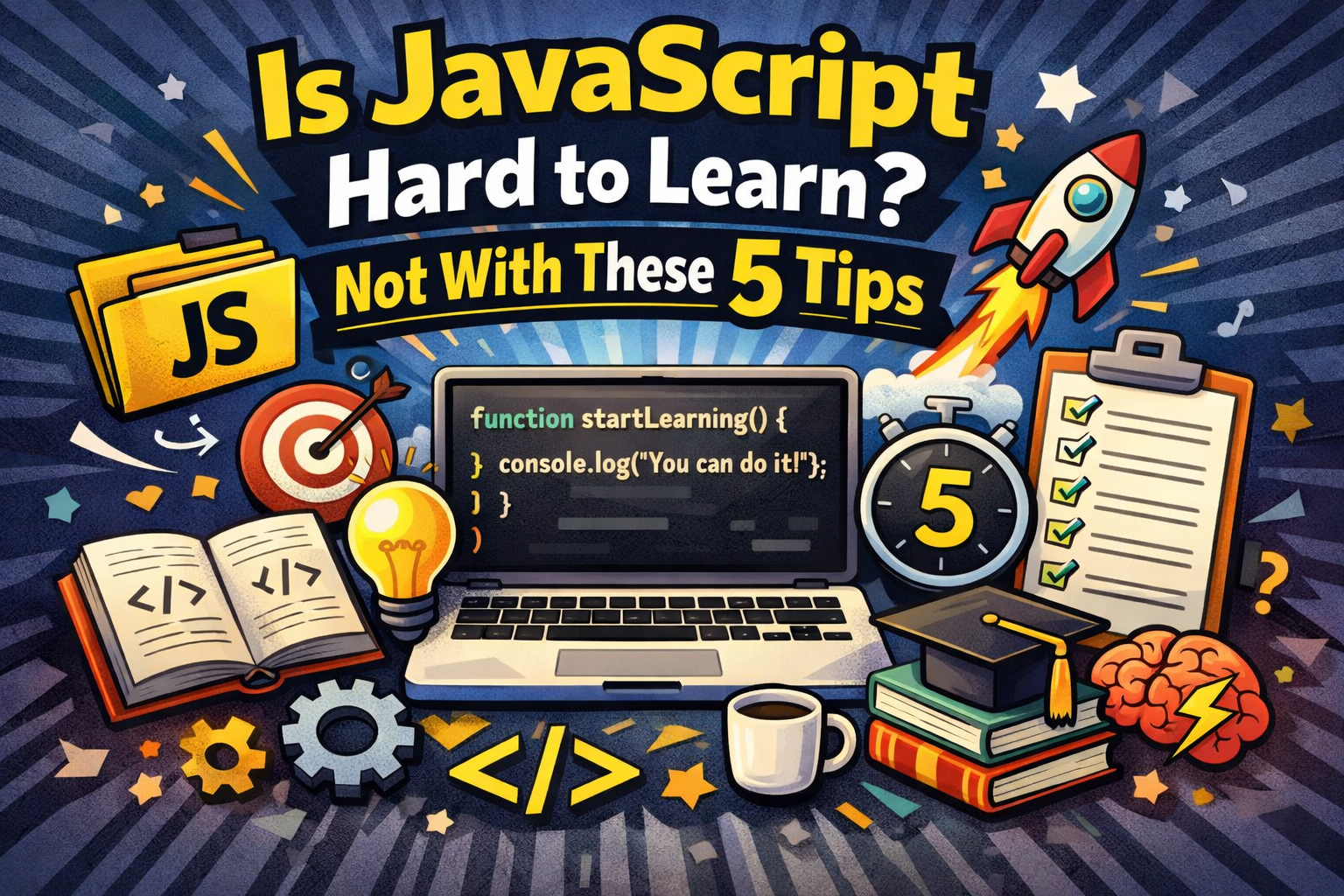
Is JavaScript Hard to Learn? Not With These 5 Tips
So you're thinking about learning JavaScript, but that nagging question keeps popping up: is JavaScript hard to learn? It's a valid concern. With its quirky syntax, asynchronous concepts, and seemingly endless frameworks, JavaScript can appear intimidating at first glance. But here's the truth – while JavaScript has its challenges, it's far from impossible to master, especially with the right approach.
In this guide, I'll walk you through five practical tips that will flatten the is javascript hard to learn curve and help you progress from confused beginner to confident developer. By the end, you'll have a clear roadmap for your JavaScript journey that sidesteps common frustrations and accelerates your progress.

Table of Contents
- Tip 1: Understand JavaScript Basics Before Frameworks
- Tip 2: Build Projects, Not Just Tutorials
- Tip 3: Learn to Debug Effectively
- Tip 4: Consistent Practice Beats Cramming
- Tip 5: Leverage Community Learning
- Common JavaScript Learning Roadblocks (And How to Overcome Them)
- Conclusion
- Frequently Asked Questions
Tip 1: Understand JavaScript Basics Before Frameworks
One of the biggest mistakes beginners make is rushing to learn popular frameworks like React or Vue without first mastering JavaScript fundamentals. This is like trying to build a house without understanding how to use the basic tools.
Core concepts to master first include:
- Variables and data types: Understanding primitives (strings, numbers, booleans) and complex types (objects, arrays)
- Functions and scope: How functions work, closures, and variable scoping
- DOM manipulation: How JavaScript interacts with HTML
- Events: Handling user interactions
- Asynchronous programming: Promises, async/await, and callbacks
According to a Stack Overflow Developer Survey, developers who master fundamentals before frameworks report fewer frustrations and better problem-solving abilities.
The is javascript hard to learn question often stems from people trying to run before they can walk. By taking the time to understand these core concepts, you'll build a solid foundation for everything else.
Tip 2: Build Projects, Not Just Tutorials
Tutorial hell is real. You follow along, everything makes sense, but when you try to code independently, you freeze. This is where the javascript learning curve can feel steepest.
The solution? Start building real projects early. Here's a progression I recommend:
- Simple DOM manipulations: Build a color changer or counter
- Form validator: Create a registration form with validation
- API integration: Build a weather app or movie search tool
- Small game: Create a memory match or simple quiz app
When you build projects, you:
- Encounter real-world problems (not just tutorial examples)
- Learn to research solutions independently
- Develop debugging skills
- Create portfolio pieces
Remember: it's better to build ten small projects than to watch fifty tutorials with no application.
Tip 3: Learn to Debug Effectively
Debugging isn't just a skill—it's a superpower. When people ask is javascript hard to learn, they're often really asking, "How hard is it to fix JavaScript when it breaks?"
Effective debugging strategies include:
- Using console.log() strategically: Log values at different points in your code
- Mastering browser DevTools: Learn to use breakpoints, watch expressions, and the call stack
- Reading error messages carefully: JavaScript errors often tell you exactly what's wrong
- Rubber duck debugging: Explain your code line-by-line to an inanimate object (or patient friend)
According to Mozilla Developer Network, developers spend 30-60% of their time debugging. By improving this skill early, you'll dramatically reduce the is javascript hard to learn frustration factor.
Tip 4: Consistent Practice Beats Cramming
JavaScript is a language, and like any language, it requires consistent practice. Coding for 30 minutes daily is far more effective than an 8-hour weekend cramming session.
Try these practice habits:
- Code kata: Solve a small coding problem daily on platforms like Codewars
- Spaced repetition: Review concepts you learned previously before tackling new ones
- Explain to learn: Try explaining concepts you've learned to someone else
- Read others' code: Examine and understand open-source projects
The javascript learning curve flattens dramatically with consistent practice. Your brain needs time to build neural connections—give it that opportunity through regular coding sessions.
Tip 5: Leverage Community Learning
No developer is an island. The JavaScript community is one of the largest and most active in programming. Use this to your advantage!
Community resources to leverage:
- Stack Overflow: For specific coding problems
- GitHub discussions: To see how developers solve real problems
- Discord/Slack communities: For real-time help and mentorship
- Code reviews: Ask for feedback on your projects
- Pair programming: Find a learning partner to code with
Studies show that collaborative learning can increase retention by up to 50%. When you're stuck wondering is javascript hard to learn, the answer often lies in connecting with others who've overcome the same challenges.
Common JavaScript Learning Roadblocks (And How to Overcome Them)
Even with great practices, you'll hit roadblocks. Here are the most common ones and how to overcome them:
Asynchronous programming confusion: Start with simple examples and gradually build complexity. Visual diagrams can help tremendously.
"This" keyword behavior: Create a cheat sheet of contexts where "this" behaves differently. Practice with examples for each case.
Callback hell: Learn promises and async/await early to avoid deeply nested callbacks.
Framework overwhelm: Remember, frameworks come and go, but core JavaScript remains. Master the language first, then pick ONE framework to learn deeply.
Imposter syndrome: Everyone feels it. Keep a "win journal" documenting problems you've solved and concepts you've mastered.
The is javascript hard to learn question often resurfaces when you hit these roadblocks. Recognize them as normal parts of the journey rather than signs you're not cut out for programming.
Conclusion
So, is javascript hard to learn? The honest answer is that it presents challenges, but with these five tips—mastering fundamentals, building projects, learning to debug, practicing consistently, and leveraging community—it's absolutely achievable.
Remember that everyone's learning journey is different. What matters isn't how quickly you progress but that you keep moving forward. The most successful developers aren't necessarily the ones who found it easiest at the beginning, but those who persisted through the difficult parts.
Now it's your turn. Which of these five tips will you implement first? Share your JavaScript learning journey in the comments below, or reach out if you have questions about getting started!
Frequently Asked Questions
How long does it take to learn JavaScript?
Most people can learn JavaScript basics in 1-3 months of consistent study. Becoming proficient enough for junior developer roles typically takes 6-12 months of dedicated practice and project building.
Do I need to know HTML and CSS before learning JavaScript?
Yes, at least at a basic level. JavaScript interacts with HTML and CSS in web applications, so understanding these technologies will make your is javascript hard to learn journey smoother.
Is JavaScript harder than Python?
JavaScript has more syntax quirks and complexity than Python, making its initial learning curve steeper. However, once you understand the core concepts, many developers find JavaScript equally approachable.
Should I learn vanilla JavaScript or jQuery first?
Always learn vanilla JavaScript first. jQuery is less commonly used in modern web development, and understanding core JavaScript will make learning any library or framework easier.
What's the hardest part of learning JavaScript?
Most beginners find asynchronous programming (promises, async/await) and the "this" keyword most challenging. Close attention to these concepts early on will help flatten the javascript learning curve.
Can I get a job knowing only JavaScript?
Yes, but you'll need to be proficient. Most JavaScript developer roles require knowledge of related technologies like HTML, CSS, and at least one popular framework like React, Angular, or Vue.
Are JavaScript certificates worth it?
Certificates matter less than a strong portfolio of projects. Employers want to see what you can build, not what courses you've completed.