
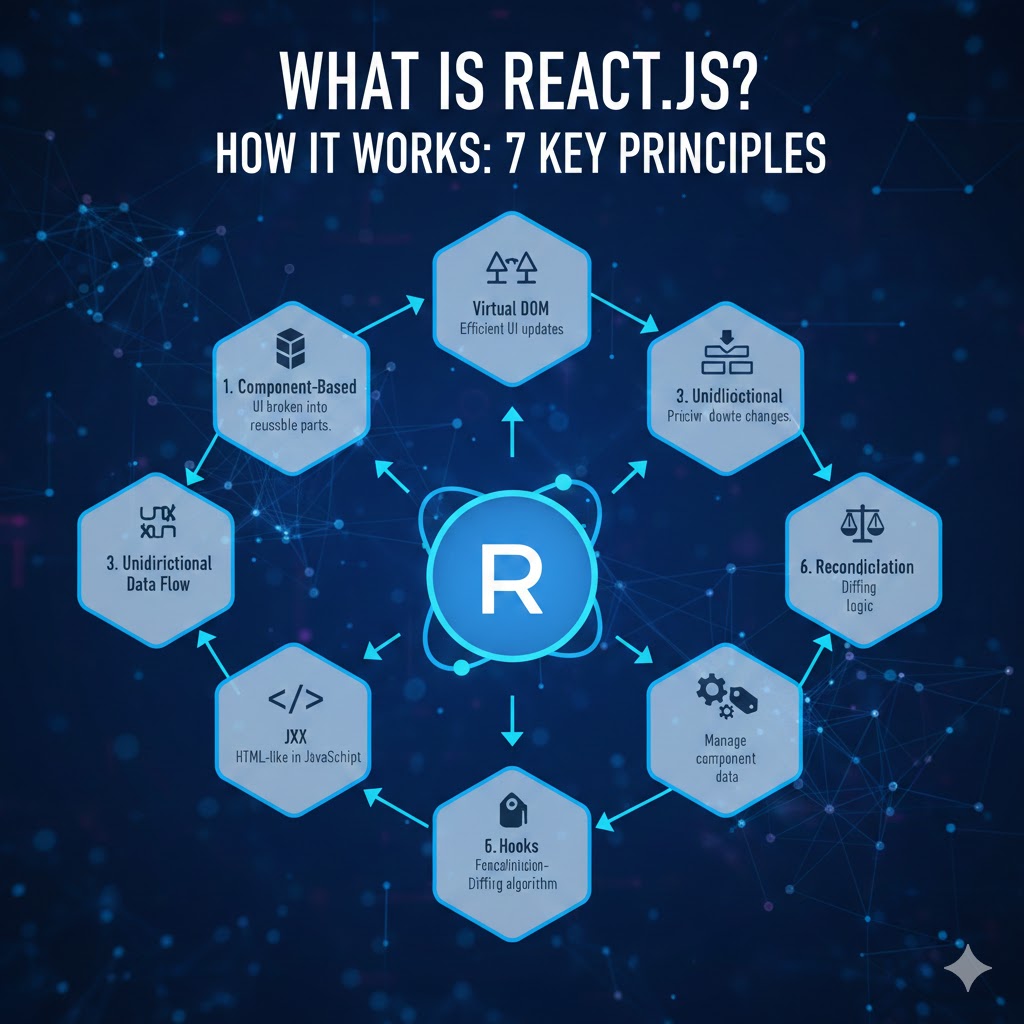
What is React.js How It Works: 7 Key Principles
Are you struggling to understand modern web development frameworks? If you're new to front-end development or looking to upgrade your skills, you've likely encountered React. But what exactly is this popular library, and why do developers love it so much? In this comprehensive guide, we'll explore what is react.js and the seven fundamental principles that make it one of the most powerful tools for building dynamic user interfaces.

Table of Contents
- Understanding React.js Fundamentals
- The Component-Based Architecture
- Virtual DOM: React's Performance Secret
- JSX: HTML Meets JavaScript
- Unidirectional Data Flow
- State Management in React
- React Hooks Revolution
- React's Ecosystem and Integration
- Conclusion
- Frequently Asked Questions
Understanding React.js Fundamentals
At its core, what is react.js? It's a JavaScript library created by Facebook (now Meta) in 2013 for building user interfaces, particularly single-page applications. Unlike full frameworks, React focuses solely on the view layer of the application, making it lightweight and flexible.
The React JS definition emphasizes its declarative nature—you tell React what you want the UI to look like, and it efficiently updates and renders the right components when your data changes. This declarative approach simplifies the coding process and makes your applications more predictable and easier to debug.
The Component-Based Architecture
React's power stems from its component-based architecture. Components are independent, reusable pieces of code that return HTML via a render function. Think of them as building blocks for your application.
There are two types of components in React:
- Functional Components: Simple JavaScript functions that accept props and return React elements
- Class Components: More feature-rich ES6 classes that extend React.Component
This modular approach offers several benefits:
- Reusability: Write once, use anywhere
- Maintainability: Isolated components are easier to update
- Testability: Test individual components in isolation
- Separation of concerns: Each component handles a specific part of the UI
// A simple functional component
function Welcome(props) {
  return <h1>Hello, {props.name}</h1>;
}

// Using the component
const element = <Welcome name="Developer" />;
Virtual DOM: React’s Performance Secret
One of the most innovative aspects of what is react.js is its implementation of the Virtual DOM. Instead of directly manipulating the browser's DOM (which is slow), React creates a lightweight copy in memory.
When state changes occur:
- React creates a new Virtual DOM representation
- It compares this with the previous version (diffing)
- It calculates the minimal number of changes needed
- It updates only the necessary parts of the actual DOM
This process, known as reconciliation, dramatically improves performance, especially in complex, dynamic applications where frequent updates occur.
JSX: HTML Meets JavaScript
JSX (JavaScript XML) is React's syntax extension that allows you to write HTML-like code directly in your JavaScript. While not required for using React, it makes your code more readable and expressive.
const element = (
  <div className="greeting">
    <h1>Hello, world!</h1>
    <p>This is JSX in action</p>
  </div>
);
Behind the scenes, JSX is compiled to regular JavaScript function calls. The above code translates to:
const element = React.createElement(
  'div',
  {className: 'greeting'},
  React.createElement('h1', null, 'Hello, world!'),
  React.createElement('p', null, 'This is JSX in action')
);
JSX may feel strange at first, but once you understand it, you'll appreciate how it combines the visual structure of HTML with the full power of JavaScript.
Unidirectional Data Flow
React implements a one-way data flow, which means data has a single direction it can travel: from parent components down to child components via props.
This unidirectional binding gives you better control over your application and makes it easier to understand how data changes affect the UI. Unlike two-way binding frameworks, React's approach is more predictable and easier to debug.
When learning what is react.js, understanding this data flow principle is crucial for building maintainable applications.
State Management in React
State represents data that changes over time in your application. React components can maintain their own internal state, which determines how they render and behave.
The React JS definition of state management involves:
- Initializing state: Setting initial values
- Reading state: Accessing current values
- Updating state: Using setState() or useState() to modify values
- State lifting: Moving state to common ancestors for sharing between components
For larger applications, external state management libraries like Redux or Context API provide more robust solutions for handling complex state interactions.
React Hooks Revolution
Introduced in React 16.8, Hooks allow you to use state and other React features without writing class components. They let you "hook into" React features from functional components.
The most commonly used hooks include:
- useState: Adds state to functional components
- useEffect: Handles side effects (similar to lifecycle methods)
- useContext: Accesses context without nesting
- useReducer: Manages complex state logic
- useRef: Creates mutable references
Hooks have revolutionized what is react.js development by simplifying code, encouraging composition over inheritance, and eliminating the need for class components in most cases.
React’s Ecosystem and Integration
React's minimal core design allows it to integrate with a vast ecosystem of tools and libraries:
- Routing: React Router for navigation
- State Management: Redux, MobX, Recoil
- UI Components: Material-UI, Ant Design, Chakra UI
- Testing: Jest, React Testing Library
- Build Tools: Create React App, Next.js, Gatsby
This flexibility is one of React's greatest strengths. You can choose exactly what you need based on your project requirements without being locked into a monolithic framework.
Conclusion
Understanding what is react.js and its core principles opens up a world of possibilities for modern web development. From its component-based architecture and Virtual DOM to the power of JSX and Hooks, React has transformed how developers build user interfaces.
Whether you're just starting your coding journey or looking to add another tool to your development arsenal, React's intuitive design philosophy and robust ecosystem make it an excellent choice for projects of any size.
Ready to start building with React? Begin with small components, master the fundamentals, and gradually explore the more advanced concepts. Share your experience in the comments below or join our community to connect with other React developers!
Frequently Asked Questions
Is React a framework or a library?
React is a JavaScript library, not a full framework. It focuses specifically on the view layer of applications, unlike frameworks like Angular that provide more comprehensive solutions.
Do I need to know JavaScript before learning React?
Yes, a solid understanding of JavaScript fundamentals is essential before learning React. Concepts like ES6 features, arrays, objects, and functions are particularly important.
Can I use React for mobile app development?
Yes, React Native allows you to build native mobile applications using React principles. The core concepts remain the same, but instead of rendering to the browser DOM, React Native targets mobile platform components.
How does React compare to Angular and Vue?
React is a library focused on UI components with a minimalist approach. Angular is a complete framework with more built-in features. Vue falls somewhere in between, offering more structure than React but less complexity than Angular.
Is React difficult to learn?
React has a relatively gentle learning curve for developers who already know JavaScript. The challenging parts typically involve understanding state management, side effects, and the ecosystem rather than React itself.
What are the disadvantages of using React?
React only handles the view layer, requiring additional libraries for routing, state management, etc. It also has a rapidly evolving ecosystem that can make keeping up with best practices challenging.
How important is TypeScript for React development?
While not required, TypeScript has become increasingly popular in React development for adding type safety. It's especially valuable for larger projects and teams, helping catch errors at compile time rather than runtime.